Filter by
Complete Atelectasis of the Lung in Patients With Primary Spontaneous Pneumot…
Complete atelectasis of primary spontaneous pneumothorax (PSP) requires immediate air reduction. Surgical intervention has been considered proper treatment for persistent air leakage or recurrence. We examined whether this is the proper treatment by evaluating the natural course and treatment outcomes of complete lung atelectasis
- Edition
- -
- ISBN/ISSN
- -
- Collation
- -
- Series Title
- -
- Call Number
- -
Three polymorphisms of tumor necrosis factor-alpha and hepatitis B virus rela…
This meta-analysis shows that AA genotype in TNF-a G308A and TNF-a G238A and CT genotype in TNF-a C863T may increase HBV-HCC risk. Therefore, HBV infection seemed to be a more important factor for tumorigenesis of HCC than genetic predisposition in G308A of TNF-a, and interaction between TNF-a C863T polymorphisms and HBV infection might be associated with increased HCC risk
- Edition
- -
- ISBN/ISSN
- -
- Collation
- -
- Series Title
- -
- Call Number
- -
S-index and APRI Score to Predict Liver Fibrosis Chronic in Hepatitis B and C…
A great interest has been dedicated to the development of non invasive predictive models in recent years to substitute liver biopsy for fibrosis assessment and follow-up. The aim of this study was to compare the accuracy between S-index and aspartate aminotransferase to platelet ratio index (APRI) to FibroScan for predicting liver fibrosis in chronic hepatitis B and C patients
- Edition
- -
- ISBN/ISSN
- -
- Collation
- -
- Series Title
- -
- Call Number
- -
The role of tumour necrosis factor in hepatitis B infection: Jekyll and Hyde
Chronic hepatitis B (CHB) is a major health problem worldwide and is associated with significant long-term morbidity and mortality. The hepatitis B virus (HBV) is a hepatotropic virus that is capable of integrating in the host nucleus permanently resulting in lifelong infection. To date, there is no definitive cure for HBV, as our current treatments cannot eradicate the viral reservoir that ha…
- Edition
- -
- ISBN/ISSN
- -
- Collation
- -
- Series Title
- -
- Call Number
- -
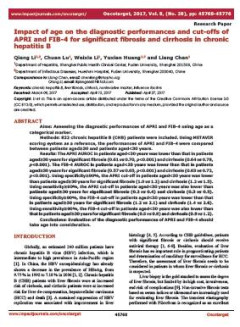
Impact of age on the diagnostic performances and cut-offs of APRI and FIB-4 f…
The APRI AUROC in patients aged
- Edition
- -
- ISBN/ISSN
- -
- Collation
- -
- Series Title
- -
- Call Number
- -
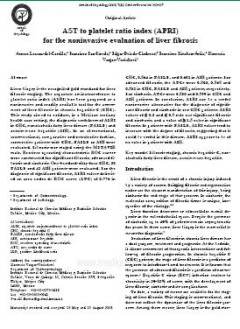
AST to platelet ratio index (APRI) for the noninvasive evaluation of liver fi…
Liver biopsy is the recognized gold standard for liver fibrosis staging. The aspartate minotransferase to platelet ratio index (APRI) has been proposed as a noninvasive and readily available tool for the assessment of liver fibrosis in chronic hepatitis C (CHC). This study aimed to validate, in a Mexican tertiary health care setting, the diagnostic usefulness of APRI in CHC, nonalcoholic fatty…
- Edition
- -
- ISBN/ISSN
- -
- Collation
- -
- Series Title
- -
- Call Number
- -
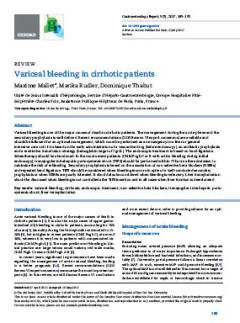
Variceal bleeding in cirrhotic patients
Variceal bleeding is one of the major causes of death in cirrhotic patients. The management during the acute phase and the secondary prophylaxis is well defined. Recent recommendations (2015 Baveno VI expert consensus) are available and should be followed for an optimal management, which must be performed as an emergency in a liver or general intensive-care unit. It is based on the early admini…
- Edition
- -
- ISBN/ISSN
- -
- Collation
- -
- Series Title
- -
- Call Number
- -
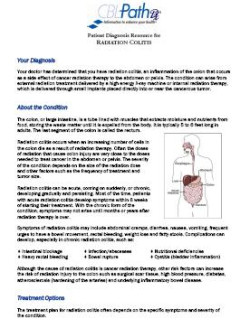
Patient Diagnosis Resource for Radiation Colitis
Your doctor has determined that you have radiation colitis, an inflammation of the colon that occurs as a side effect of cancer radiation therapy to the abdomen or pelvis. The condition can arise from external radiation treatment delivered by a high energy X-ray machine or internal radiation therapy, which is delivered through small implants placed directly into or near the cancerous tumor
- Edition
- -
- ISBN/ISSN
- -
- Collation
- -
- Series Title
- -
- Call Number
- -
Idiopathic Noncirrhotic Portal Hypertension
Cirrhosis is the most common cause of portal hypertension but a heterogeneous group of clinical entities, collectively referred to as non-cirrhotic portal hypertension (NCPH), can also lead to elevation of the portal venous pressure in the absence of cirrhosis. Common causes of NCPH are nonalcoholic or alcoholic steatohepatitis, primary biliary cholangitis, primary sclerosing cholangitis, conge…
- Edition
- -
- ISBN/ISSN
- -
- Collation
- -
- Series Title
- -
- Call Number
- -
2018 International Consensus on Cardiopulmonary Resuscitation and Emergency C…
The International Liaison Committee on Resuscitation has initiated a continuous review of new, peer-reviewed, published cardiopulmonary resuscitation science. This is the second annual summary of International Consensus on Cardiopulmonary Resuscitation and Emergency Cardiovascular Care Science With Treatment Recommendations that includes the most recent cardiopulmonary resuscitation science rev…
- Edition
- -
- ISBN/ISSN
- -
- Collation
- -
- Series Title
- -
- Call Number
- -
 Computer Science, Information & General Works
  Philosophy & Psychology
  Religion
  Social Sciences
  Language
  Pure Science
  Applied Sciences
  Art & Recreation
  Literature
  History & Geography