Filter by
The New Xpert MTB/RIF Ultra: Improving Detection of Mycobacterium tuberculosi…
The Xpert MTB/RIF assay (Xpert) is a rapid test for tuberculosis (TB) and rifampin resistance (RIF-R) suitable for point-of-care testing. However, it has decreased sensitivity in smear-negative sputum, and false identification of RIF-R occasionally occurs. We developed the Xpert MTB/RIF Ultra assay (Ultra) to improve performance. Ultra and Xpert limits of detection (LOD), dynamic ranges, and R…
- Edition
- -
- ISBN/ISSN
- -
- Collation
- -
- Series Title
- -
- Call Number
- -
Xpert MTB/RIF Ultra for detection of Mycobacterium tuberculosis and rifampici…
The Xpert MTB/RIF assay is an automated molecular test that has improved the detection of tuberculosis and rifampicin resistance, but its sensitivity is inadequate in patients with paucibacillary disease or HIV. Xpert MTB/RIF Ultra (Xpert Ultra) was developed to overcome this limitation. We compared the diagnostic performance of Xpert Ultra with that of Xpert for detection of tuberculosis and…
- Edition
- -
- ISBN/ISSN
- -
- Collation
- -
- Series Title
- -
- Call Number
- -
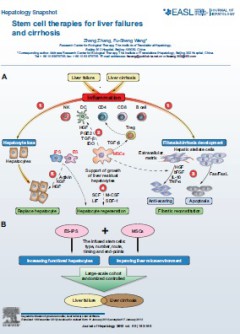
Stem cell therapies for liver failures and cirrhosis
Liver failure and cirrhosis occur as a result of a variety of chronic hepatic injuries. They display sequential and overlapping severe pathogenic processes that include severe inflammation, hepatocyte necrosis, and fibrosis/cirrhosis, and carry a high mortality rate
- Edition
- -
- ISBN/ISSN
- -
- Collation
- -
- Series Title
- -
- Call Number
- -
The role of nitric oxide in cardiovascular diseases
Nitric oxide (NO) is a gaseous lipophilic free radical cellular messenger generated by three distinct isoforms of nitric oxide synthases (NOS), neuronal (nNOS), inducible (iNOS) and endothelial NOS (eNOS). NO plays an important role in the protection against the onset and progression of cardiovascular disease. Cardiovascular disease is associated with a number of different disorders including h…
- Edition
- -
- ISBN/ISSN
- -
- Collation
- -
- Series Title
- -
- Call Number
- -
Nitric oxide and cardiac function
Nitric oxide (NO) participates in the control of contractility and heart rate, limits cardiac remodeling after an infarction and contributes to the protective effect of ischemic pre- and postconditioning. Low concentrations of NO, with production of small amounts of cGMP, inhibit phosphodiesterase III, thus preventing the hydrolysis of cAMP. The subsequent activation of a protein-kinase A cause…
- Edition
- -
- ISBN/ISSN
- -
- Collation
- -
- Series Title
- -
- Call Number
- -
Transfusion Management of Obstetric Hemorrhage
The importance of transfusion medicine in the management of postpartum hemorrhage (PPH) cannot be overstated and is reflected in the historical record with the first series of successful human-to-human transfusions being performed by James Blundell in 1818, a London obstetrician treating patients with PPH
- Edition
- -
- ISBN/ISSN
- -
- Collation
- -
- Series Title
- -
- Call Number
- -
Developing a Systematic Approach to Obstetric Emergencies
Comparison of pre- and postassessments revealed improvements in perceived confidence and competence when managing obstetric emergencies. Nurse confidence increased by 35% and nurse competence increased by 32%. The 2-day educational program also realized significant cost savings. Overall costs for the educational program decreased from $94849 to $42974.
- Edition
- -
- ISBN/ISSN
- -
- Collation
- -
- Series Title
- -
- Call Number
- -
Implications of diabetes in obstetric anaesthesia
Diabetes during pregnancy can be classified as gestational diabetes mellitus (GDM) or pre-existing diabetes. Many women identified as having diabetes mellitus for the first time in pregnancy are classified as having GDM, although they may actually have pre-existing diabetes. This diagnosis has significant implications for obstetric anaesthesia with regards to maternal and fetal outcomes.
- Edition
- -
- ISBN/ISSN
- -
- Collation
- -
- Series Title
- -
- Call Number
- -
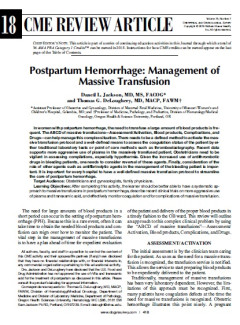
Postpartum Hemorrhage: Management of Massive Transfusion
In women with postpartumhemorrhage, the need to transfuse a large amount of blood products is frequent. The ABCD ofmassive transfusions—Assessment/Activation, Blood products, Complications, and Drugs—can helpmanage this complex situation. There needs to be a definedmethod to activate themassive transfusion protocol and a well-defined means to assess the coagulation status of the patient …
- Edition
- -
- ISBN/ISSN
- -
- Collation
- -
- Series Title
- -
- Call Number
- -
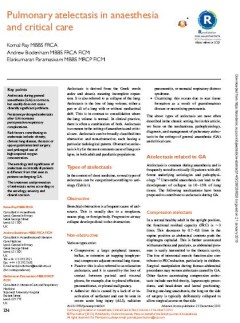
Pulmonary atelectasis in anaesthesia and critical care
Atelectasis is derived from the Greek words ateles and ektasis, meaning incomplete expansion. It is also referred to as collapse of the lung. Atelectasis is the loss of lung volume, either a part or all of a lung with or without mediastinal shift.
- Edition
- -
- ISBN/ISSN
- -
- Collation
- -
- Series Title
- -
- Call Number
- -
 Computer Science, Information & General Works
  Philosophy & Psychology
  Religion
  Social Sciences
  Language
  Pure Science
  Applied Sciences
  Art & Recreation
  Literature
  History & Geography