Filter by
Acute Hepatitis
Acute hepatitis is a nonspecific term that refers to an acute inflammation of the liver resulting from a wide range of etiologies. Even though the presentation may be acute, it does not always result from an acute disease process. Many of the etiologies may have a long-standing silent disease process preceding the acute presentation. The clinical presentation can be overlapping and therefore…
- Edition
- -
- ISBN/ISSN
- -
- Collation
- -
- Series Title
- -
- Call Number
- -
Acute infectious hepatitis in hospitalised children: a British Paediatric Sur…
Hepatitis remains a key public health priority globally. Most childhood cases are caused by viruses, especially hepatitis A virus (HAV) and hepatitis B virus (HBV). This study aimed to estimate the burden of acute infectious hepatitis in hospitalised children and to describe their clinical characteristics and outcomes
- Edition
- -
- ISBN/ISSN
- -
- Collation
- -
- Series Title
- -
- Call Number
- -
Acute hepatitis A is the chief etiology of acute hepatitis in Egyptian childr…
Acute hepatic illness is an important health issue in children. Our work aimed to determine the prevalence of viral hepatitis in symptomatic children. It is a prospective cohort study of 268 children presented with acute hepatitis. Complete blood count, liver panel, and anti-hepatitis Avirus (HAV) IgM were done initially. Cases negative for HAV were tested for anti-hepatitis E (HEV) IgM, ant…
- Edition
- -
- ISBN/ISSN
- -
- Collation
- -
- Series Title
- -
- Call Number
- -
Use of Diphtheria Antitoxin (DAT) for Suspected Diphtheria Cases IND
The purpose of this Investigational New Drug (IND) protocol is to provide access to diphtheria antitoxin (DAT) for emergency treatment of suspected diphtheria cases and, under exceptional circumstances, to provide passive, transient protection against diphtheria toxin in an exposed contact. A FDA-licensed diphtheria antitoxin product is unavailable in the United States.
- Edition
- -
- ISBN/ISSN
- -
- Collation
- -
- Series Title
- -
- Call Number
- -
Characterization of serum anti-diphtheria antibody activity following adminis…
There is a global shortage of equine-derived diphtheria anti-toxin (DAT) for diphtheria treatment. There are few existing data on serum antibody concentrations and neutralizing activity post-treatment to support development of new therapeutics. Antibody concentrations were quantified by ELISA and anti-toxin neutralizing activity by cytotoxicity assay in serum from 4 patients receiving DAT for s…
- Edition
- -
- ISBN/ISSN
- -
- Collation
- -
- Series Title
- -
- Call Number
- -
Access to diphtheria antitoxin for therapy and diagnostics
The most effective treatment for diphtheria is swift administration of diphtheria antitoxin (DAT) with conjunct antibiotic therapy. DAT is an equine immunoglobulin preparation and listed among the World Health Organization Essential Medicines. Essential Medicines should be available in functioning health systems at all times in adequate amounts, in appropriate dosage forms, with assured qualit…
- Edition
- -
- ISBN/ISSN
- -
- Collation
- -
- Series Title
- -
- Call Number
- -
RISK FACTORS OF DIPHTHERIA CARRIERS IN INDONESIAN CHILDREN
Indonesia has one of the highest prevalence of diphtheria in the world, with East Java the most heavily affected. Despite the significant role of carriers in diphtheria transmission, studies in the country are still very limited. This study analyzed risk factors of children becoming diphtheria carriers using an observational case-control approach carried out from 2011 and 2015, which employed d…
- Edition
- -
- ISBN/ISSN
- -
- Collation
- -
- Series Title
- -
- Call Number
- -
Risk factors for incomplete vaccination and missed opportunity for immunizati…
Inadequate levels of immunization against childhood diseases remain a significant public health problem in resource-poor areas of the globe. Nonetheless, the reasons for incomplete vaccination and non-uptake of immunization services are poorly understood. This study aimed at finding out the reasons for non-vaccination and the magnitude of missed opportunities for vaccination in children less t…
- Edition
- -
- ISBN/ISSN
- -
- Collation
- -
- Series Title
- -
- Call Number
- -
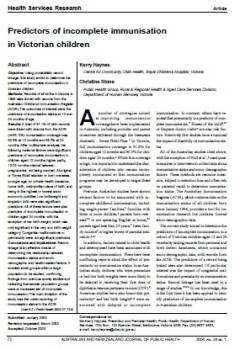
Predictors of incomplete immunisation in Victorian children
A number of strategies aimed at improving immunisation coveragehave been implemented in Australia, including provider and parent incentives delivered through the Immunise Australia – Seven Point Plan.1 In Victoria, full immunisation coverage is 91.8% for children aged 12 months and 90.5% for children aged 24 months.2 While this coverage is high, it is important to understand the characteristi…
- Edition
- -
- ISBN/ISSN
- -
- Collation
- -
- Series Title
- -
- Call Number
- -
Drug-eluting stents versus bare-metal stents for acute coronary syndrome (Review
Approximately 3.7 million people died from acute coronary syndrome worldwide in 2012. Acute coronary syndrome, also known as myocardial infarction or unstable angina pectoris, is caused by a sudden blockage of the blood supplied to the heartmuscle. Percutaneous coronary intervention is often used for acute coronary syndrome, but previous systematic reviews on the effects of drug-eluting stents …
- Edition
- -
- ISBN/ISSN
- -
- Collation
- -
- Series Title
- -
- Call Number
- -
 Computer Science, Information & General Works
  Philosophy & Psychology
  Religion
  Social Sciences
  Language
  Pure Science
  Applied Sciences
  Art & Recreation
  Literature
  History & Geography