Filter by
Short-Term Memory and Aphasia: From Theory to Treatment
This article reviews existing research on the interactions between verbal short-term memory and language processing impairments in aphasia. Theoretical models of short-term memory are reviewed, starting with a model assuming a separation between short-term memory and language, and progressing to models that view verbal short-term memory as a cognitive requirement of language processing. The rev…
- Edition
- -
- ISBN/ISSN
- -
- Collation
- -
- Series Title
- -
- Call Number
- -
Home-based therapy for chronic Wernicke’s aphasia
Many stroke survivors experience language impairments (aphasia) beyond 6 months to 1 year after the stroke. Language is a fundamental element in human interaction, and aphasia is independently associated with less participation in rehabilitation programmes, depression and worse quality of life
- Edition
- -
- ISBN/ISSN
- -
- Collation
- -
- Series Title
- -
- Call Number
- -
Viral Hepatitis in Pregnancy – A study of its Effect on Maternal and Foetal…
The outcome of Hepatitis during pregnancy has been observed to be widely different by various authors, ranging from the benign to fatal. A poor outcome has increasingly been observed in pregnant women suffering from Hepatitis in Central India. Hence, this study was undertaken to study the incidence, causative organisms and chief prognostic factors affecting the outcome of viral hepatitis in pre…
- Edition
- -
- ISBN/ISSN
- -
- Collation
- -
- Series Title
- -
- Call Number
- -
Metformin inhibits hepatitis B virus protein production and replication in hu…
Hepatitis B virus surface antigen (HBsAg) plays an important role in maintaining the tolerance and may interfere with host innate and adaptive immune responses; therefore, novel therapeutic strategies to reduce HBsAg loads in patients infected with hepatitis B virus (HBV) are emerging as an attractive but challenging issue. Metformin could regulate hepatic metabolism while the latter interacts …
- Edition
- -
- ISBN/ISSN
- -
- Collation
- -
- Series Title
- -
- Call Number
- -
Metformin: New Preparations and Nonglycemic Benefits
Metformin has been widely used for over 5 decades. New preparations have been developed for possible enhancement of efficiency, tolerability, and pleiotropic nonglycemic effects. Extended-release metformin has contributed to adherence and improved gastrointestinal tolerability. Delayed-release metformin acts in the lower gastrointestinal tract and exerts glucose-lowering effects at lower plasma…
- Edition
- -
- ISBN/ISSN
- -
- Collation
- -
- Series Title
- -
- Call Number
- -
Metformin and metabolic diseases: a focus on hepatic aspects
Metformin has been widely used as a first-line anti-diabetic medicine for the treatment of type 2 diabetes (T2D). As a drug that primarily targets the liver, metformin suppresses hepatic glucose production (HGP), serving as the main mechanism by which metformin improves hyperglycemia of T2D. Biochemically, metformin suppresses gluconeogenesis and stimulates glycolysis. Metformin also inhibit…
- Edition
- -
- ISBN/ISSN
- -
- Collation
- -
- Series Title
- -
- Call Number
- -
Targeted Therapy as an Alternative to Whole-Brain Radiotherapy in EGFR-Mutant…
Patients with advanced EGFR-mutant or ALK-positive non–smallcell lung cancer (NSCLC) have a high cumulative risk (>70%) for developing brainmetastases (BrM) during the course of their disease. Recently, an update of the graded prognostic assessment (GPA) for patients with NSCLCandBrMhas established that molecular alterations in EGFR or ALK are an independent prognostic factor for betteroutcomes.
- Edition
- -
- ISBN/ISSN
- -
- Collation
- -
- Series Title
- -
- Call Number
- -
Role of chemotherapy and targeted therapy in early-stage non-small cell lung …
Adjuvant platinum based chemotherapy is accepted as standard of care in stage II and III non-small cell lung cancer (NSCLC) patients and is often considered in patients with stage IB disease who have tumors ≥ 4 cm. The survival advantage is modest with approximately 5% at 5 years
- Edition
- -
- ISBN/ISSN
- -
- Collation
- -
- Series Title
- -
- Call Number
- -
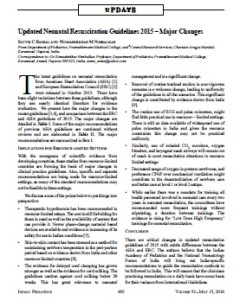
Updated Neonatal Resuscitation Guidelines 2015 – Major Changes
The latest guidelines on neonatal resuscitation from American Heart Association (AHA) [1] and European Resuscitation Council (ERC) [2] were released in October 2015. There have been slight variations between these guidelines; although they use nearly identical literature for evidence evaluation. We present here the major changes in the recent guidelines [3,4], and comparison between the ERC a…
- Edition
- -
- ISBN/ISSN
- -
- Collation
- -
- Series Title
- -
- Call Number
- -
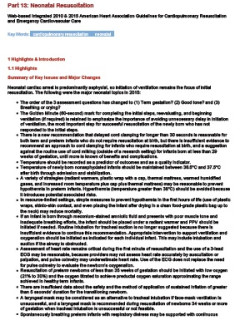
Neonatal Resuscitation
Neonatal cardiac arrest is predominantly asphyxial, so initiation of ventilation remains the focus of initial resuscitation
- Edition
- -
- ISBN/ISSN
- -
- Collation
- -
- Series Title
- -
- Call Number
- -
 Computer Science, Information & General Works
  Philosophy & Psychology
  Religion
  Social Sciences
  Language
  Pure Science
  Applied Sciences
  Art & Recreation
  Literature
  History & Geography