Filter by
Paediatric tuberculosis
Tuberculosis continues to cause an unacceptably high toll of disease and death among children worldwide, particularly in the wake of the HIV epidemic. Increased international travel and immigration have led to a rise in childhood tuberculosis rates even in traditionally low burden, industrialised settings, and threaten to promote the emergence and spread of multidrug-resistant strains. Where…
- Edition
- -
- ISBN/ISSN
- -
- Collation
- -
- Series Title
- -
- Call Number
- -

Malignant pleural effusion: from bench to bedside
Malignant pleural effusion (MPE) is a common but serious condition that is related with poor quality of life, morbidity and mortality. Its incidence and associated healthcare costs are rising and its management remains palliative, with median survival ranging from 3 to 12 months. During the last decade there has been significant progress in unravelling the pathophysiology of MPE, as well as its…
- Edition
- -
- ISBN/ISSN
- -
- Collation
- -
- Series Title
- -
- Call Number
- -

Comparing approaches to the management of malignant pleural effusions
Management of symptomatic malignant pleural effusions is becoming more complex due to the range of treatment options, which include therapeutic thoracenteses, thoracoscopic talc pleurodesis, bedside pleurodesis with talc or other sclerosing agents via small-bore chest catheters, indwelling pleural catheters, surgery, or a combination of some of these procedures
- Edition
- -
- ISBN/ISSN
- -
- Collation
- -
- Series Title
- -
- Call Number
- -
Can malignant and inflammatory pleural effusions in dogs be distinguished usi…
Computed tomography (CT) is the primary imaging modality used to investigate human patients with suspected malignant or inflammatory pleural effusion, but there is a lack of information about the clinical use of this test in dogs. To identify CT signs that could be used to distinguish pleural malignant neoplasia from pleuritis, a retrospective case-control study was done based on dogs that had …
- Edition
- -
- ISBN/ISSN
- -
- Collation
- -
- Series Title
- -
- Call Number
- -
Twin-twin transfusion syndrome (TTTS)
The etiology of TTTS is connected with the architecture of the placenta, and intertwine vascular connections known as anastomoses within the placenta. Actually all MC placentas have anastomoses that connect the fetal circulations. Fortunately, not all MC twins develop TTTS. Three main types of anastomoses might be distinguished: venovenous (VV), arterioarterial (AA), and arteriovenous (AV). …
- Edition
- -
- ISBN/ISSN
- -
- Collation
- -
- Series Title
- -
- Call Number
- -
Amount of polyhydramnios attributable to diabetes may be less than previously…
One thousand five hundred and forty-five patients were included in the study. Eight point five percent (n = 131) had diabetes and no other cause for polyhydramnios. Eleven point two percent (173) had antenatally diagnosed anomalies. For all categories of AFI except the largest (> 40.9 cm) the most common cause of polyhydramnios was idiopathic. In patients with diabetes the AFI was most likely t…
- Edition
- -
- ISBN/ISSN
- -
- Collation
- -
- Series Title
- -
- Call Number
- -
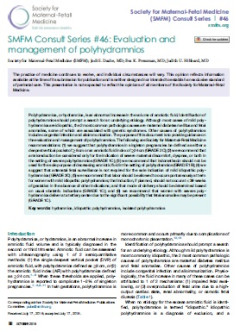
SMFM Consult Series #46: Evaluation and management of polyhydramnios
Polyhydramnios, or hydramnios, is an abnormal increase in the volume of amniotic fluid. Identification of polyhydramnios should prompt a search for an underlying etiology. Although most cases of mild polyhydramnios are idiopathic, the 2most common pathologic causes arematernal diabetes mellitus and fetal anomalies, some of which are associated with genetic syndromes. Other causes of polyhydr…
- Edition
- -
- ISBN/ISSN
- -
- Collation
- -
- Series Title
- -
- Call Number
- -
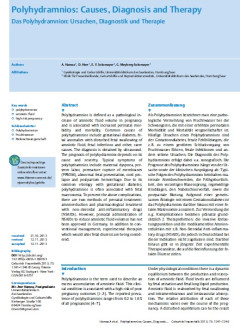
Polyhydramnios: Causes, Diagnosis and Therapy
Polyhydramnios is defined as a pathological increase of amniotic fluid volume in pregnancy and is associated with increased perinatal morbidity and mortality. Common causes of polyhydramnios include gestational diabetes, fetal anomalies with disturbed fetal swallowing of amniotic fluid, fetal infections and other, rarer causes
- Edition
- -
- ISBN/ISSN
- -
- Collation
- -
- Series Title
- -
- Call Number
- -

Clinical trials in progressive multiple sclerosis: lessons learned and future…
Progressive multiple sclerosis is characterized by the gradual accrual of disability independent of relapses and can occur with disease onset (primary progressive) or preceded by a relapsing disease course (secondary progressive). An effective disease modifying treatment for progressive multiple sclerosis has not been identified, and the results of clinical trials to date have been generally di…
- Edition
- -
- ISBN/ISSN
- -
- Collation
- -
- Series Title
- -
- Call Number
- -

Multiple sclerosis in children: an update on clinical diagnosis, therapeutic …
The clinical features, diagnostic challenges, neuroimaging appearance, therapeutic options, and pathobiological research progress in childhood—and adolescent—onset multiple sclerosis have been informed by many new insights in the past 7 years. National programmes in several countries, collaborative research efforts, and an established international paediatric multiple sclerosis study group …
- Edition
- -
- ISBN/ISSN
- -
- Collation
- -
- Series Title
- -
- Call Number
- -
 Computer Science, Information & General Works
  Philosophy & Psychology
  Religion
  Social Sciences
  Language
  Pure Science
  Applied Sciences
  Art & Recreation
  Literature
  History & Geography