Filter by
Penatalaksanaan stomatitis aftosa rekuren mayor dengan infeksi sekunder
Stomatitis aftosa rekuren (SAR) adalah kondisi ulseratif pada mukosa oral tanpa adanya kelainan lain. Karakteristik SAR adalah ulserasi bulat, dangkal, rekuren yang dikelilingi oleh inflamasi dan terutama melibatkan mukosa nonkeratinisasi. Klasifikasi SAR adalah minor, mayor, dan herpetiformis. Infeksi sekunder jarang terjadi. Perawatan ditujukan untuk menghindari trauma lokal, mengurangi rasa …
- Edition
- -
- ISBN/ISSN
- -
- Collation
- -
- Series Title
- -
- Call Number
- -
Recurrent aphthous stomatitis and Helicobacter pylori
Recurrent aphthous stomatitis (RAS) is a recurrent painful ulcerative disorder that commonly affects the oral mucosa. Local and systemic factors such as trauma, food sensitivity, nutritional deficiencies, systemic conditions, immunological disorders and genetic polymorphisms are associated with the development of the disease. Helicobacter pylori (H. pylori) is a gram-negative, microaerophile ba…
- Edition
- -
- ISBN/ISSN
- -
- Collation
- -
- Series Title
- -
- Call Number
- -

The association between minor recurrent aphthous stomatitis (RAS), children 
Minor Recurrent Aphthous Stomatitis (RAS) represents a disease which is very difficult to prevent. This case-control study focused on possible associations between minor Recurrent Aphthous Stomatitis in children, their oral health, and underlying behavioral indexes of children’s attitudes and habits pertaining to (home) oral hygiene, with the further goal of enabling the dentist to prevent th…
- Edition
- -
- ISBN/ISSN
- -
- Collation
- -
- Series Title
- -
- Call Number
- -
Short- and long-term cognitive effects of deep brain stimulation in the cauda…
growing number of studies are showing positive effects of deep brain stimulation (DBS) in the caudal zona incerta (cZi) in various tremor disorders, as well as motor symptoms of Parkinson’s disease (PD). The focus of the present study was to evaluate short- and long-term cognitive effects of bilateral cZi DBS in patients with PD.
- Edition
- -
- ISBN/ISSN
- -
- Collation
- -
- Series Title
- -
- Call Number
- -
Ultrasound-guided superior laryngeal nerve block assists in anesthesia for br…
Evolving techniques in the field of therapeutic bronchoscopy have led to the return of rigid bronchoscopy in the treatment of complex central airway disease. Rigid bronchoscopy is typically performed under general anesthesia because of the strong stimulation caused by metal instruments. Anesthesia for rigid bronchoscopy is challenging to administer because anesthesiologists and interventioni…
- Edition
- -
- ISBN/ISSN
- -
- Collation
- -
- Series Title
- -
- Call Number
- -
Upper Airway Nerve Block for Rigid Bronchoscopy in the Patients with Tracheal…
Rigid bronchoscopy is often used to diagnose and treat the location of resection of the tracheal stenosis. It is a selective procedure for the dilatation of tracheal stenosis, especially when accompanied by respiratory distress
- Edition
- -
- ISBN/ISSN
- -
- Collation
- -
- Series Title
- -
- Call Number
- -
Long-Standing Parotid Mass Associated With Pain and Pruritus in a 14-Year-Old
A 14-year-old girl presented with a 3-year history of a worsening itching sensation and intermittent pain in the region of the left parotid gland when drinking fluids. The pain lasted from a few minutes up to an hour. She denied dysphagia, odynophagia, numbness, tingling, and facial weakness.
- Edition
- -
- ISBN/ISSN
- -
- Collation
- -
- Series Title
- -
- Call Number
- -
Long-Term Follow-Up After Maxillary Sinus Balloon Sinuplasty and ESS
The aim of this controlled follow-up study was to compare the need for revision surgery, long-term efficacy, and satisfaction in chronic rhinosinusitis patients who had undergone maxillary sinus operation with either balloon sinuplasty or traditional endoscopic sinus surgery (ESS) technique
- Edition
- -
- ISBN/ISSN
- -
- Collation
- -
- Series Title
- -
- Call Number
- -
Transcutaneous Sonography for Detection of the Cervical Vagus Nerve
Cervical vagus nerve is not identified by computed tomography or magnetic resonance imaging. Transcutaneous sonography may be the best imaging study to evaluate the cervical vagus nerve. A 7 to 18 MHz linear array transducer was placed transversely on the lateral neck focusing on the carotid sheath from the clavicle level upward to the digastric muscle level bilaterally. The grayscale techni…
- Edition
- -
- ISBN/ISSN
- -
- Collation
- -
- Series Title
- -
- Call Number
- -
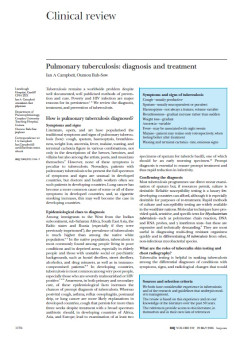
Pulmonary tuberculosis: diagnosis and treatment
Tuberculosis remains a worldwide problem despite well documented, well publicised methods of prevention and cure. Poverty and HIV infection are major reasons for its persistence.1 2 We review the diagnosis, treatment, and prevention of tuberculosis
- Edition
- -
- ISBN/ISSN
- -
- Collation
- -
- Series Title
- -
- Call Number
- -
 Computer Science, Information & General Works
  Philosophy & Psychology
  Religion
  Social Sciences
  Language
  Pure Science
  Applied Sciences
  Art & Recreation
  Literature
  History & Geography