Filter by
American College of Rheumatology/Association of Rheumatology Health Professio…
The American College of Rheumatology (ACR)/ Association of Rheumatology Health Professionals (ARHP) Annual Meeting, held November 12–16, 2016, in Washington, D.C., drew more than 16,700 attendees from around the world and featured the latest in research, diagnosis, and treatment in rheumatology. Selected highlights follow.
- Edition
- -
- ISBN/ISSN
- -
- Collation
- -
- Series Title
- -
- Call Number
- -
Canakinumab in patients with systemic juvenile idiopathic arthritis and activ…
To evaluate the long-term efficacy and safety of canakinumab in patients with active systemic juvenile idiopathic arthritis (JIA).
- Edition
- -
- ISBN/ISSN
- -
- Collation
- -
- Series Title
- -
- Call Number
- -
Methotrexate in juvenile idiopathic arthritis: advice and recommendations fro…
Conventional pharmacological therapies for the treatment of juvenile idiopathic arthritis (JIA) consist of non-biological, disease-modifying antirheumatic drugs, among which methotrexate (MTX) is the most commonly prescribed. However, there is a lack of consensus-based clinical and therapeutic recommendations for the use of MTX in the management of patients with JIA. Therefore, the Methotrexate…
- Edition
- -
- ISBN/ISSN
- -
- Collation
- -
- Series Title
- -
- Call Number
- -
Physical activity in patients with oligo- and polyarticular juvenile idiopath…
Knowledge about objectively measured levels of physical activity (PA) and PA participation (included facilitators and barriers for PA) in patients with juvenile idiopathic arthritis (JIA) diagnosed in the era of biologics is limited. We aimed to compare objectively measured PA in patients with oligo- and polyarticular JIA diagnosed in the biologic era with controls and to examine association…
- Edition
- -
- ISBN/ISSN
- -
- Collation
- -
- Series Title
- -
- Call Number
- -
Comparison of total blood volume in normal, preeclamptic, and nonproteinuric …
Our purpose was to demonstrate reduced blood volume in preeclampsia compared with nonproteinuric gestational hypertension and normal pregnancy by use of independent measures of red blood cell and plasma volumes.
- Edition
- -
- ISBN/ISSN
- -
- Collation
- -
- Series Title
- -
- Call Number
- -
Current Treatment of Bacterial Vaginosis - limitations and Need for Innovation
Practitioners and patients alike widely recognize the limitations of current therapeutic approaches to the treatment of bacterial vaginosisrn(BV). Options remain extremely limited, and our inability to prevent the frequently, often relentless symptomatic recurrences of BV and to reduce serious sequelae such as preterm delivery, remains an acknowledged but unresolved shortcoming. Our incomplete …
- Edition
- -
- ISBN/ISSN
- -
- Collation
- -
- Series Title
- -
- Call Number
- -
Autoimmune haemolytic anaemia emerging during Campath treatment in a patient …
Campath is being employed for the treatment of autoimmune haemolytic anemia (AIHA) whether or not associated to B cell chronic lymphoid leukaemia (CLL). CD5 negative CLL is relatively uncommon and runs an indolent course. We report a CD5 negative CLL patient who developed AIHA associated with cytomegalovirus infection reactivation whilst on treatment with Campath for progressive disease.
- Edition
- -
- ISBN/ISSN
- -
- Collation
- -
- Series Title
- -
- Call Number
- -
Impact of erdosteine on chronic bronchitis and COPD: A meta-analysis
A previous meta-analysis suggested that the treatment with erdosteine was associated with significant amelioration of the cumulative global efficacy index and symptoms in comparison to placebo or other mucolytics. However, this conclusion was criticized because the meta-analysis, as it had been done, made it impossible to preclude the potential operation of selection biases within and across t…
- Edition
- -
- ISBN/ISSN
- -
- Collation
- -
- Series Title
- -
- Call Number
- -

Prevention of taxane-associated acute pain syndrome with etoricoxib for patie…
For patients with breast cancer who receive docetaxel chemotherapy, taxane-associated acute pain syndrome (T-APS), considered a form of neural pathology, is a significant clinical problem. We evaluated the effect of prophylactic etoricoxib on T-APS in patients with breast cancer.
- Edition
- -
- ISBN/ISSN
- -
- Collation
- -
- Series Title
- -
- Call Number
- -
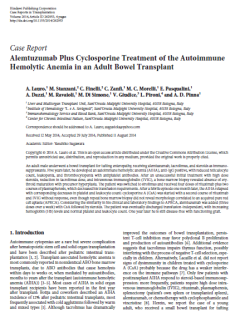
Alemtuzumab Plus Cyclosporine Treatment of the Autoimmune Hemolytic Anemia in…
An adult male underwent a bowel transplant for tufting enteropathy, receiving alemtuzumab, tacrolimus, and steroids as immunosuppressants. Five years later, he developed an autoimmune hemolytic anemia (AIHA), anti-IgG positive, with reduced reticulocyte count, leukopenia, and thrombocytopenia with antiplatelet antibodies. After an unsuccessful initial treatment with high dose steroids, reductio…
- Edition
- -
- ISBN/ISSN
- -
- Collation
- -
- Series Title
- -
- Call Number
- -
 Computer Science, Information & General Works
  Philosophy & Psychology
  Religion
  Social Sciences
  Language
  Pure Science
  Applied Sciences
  Art & Recreation
  Literature
  History & Geography